Biggest factor
Heat, and time spent sitting at a very high state of charge
Fast charging
Matters on NMC packs, matters far less on LFP
What we read
DC to AC session ratio, habitual charge level, cell voltage spread
"No home charger" is the single most common thing sellers apologise for and the single most over-weighted factor in used EV pricing. On the right chemistry it is close to irrelevant.
The two charging diets
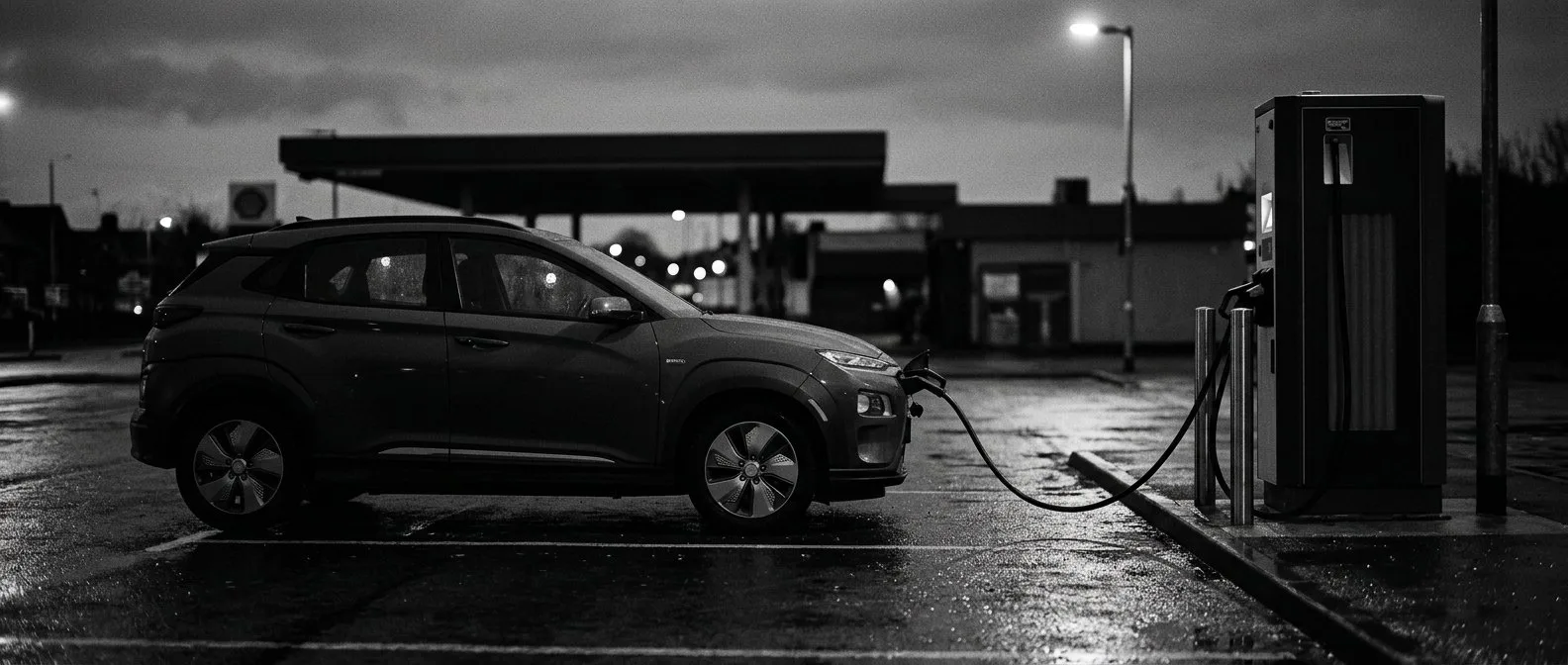
Broadly, used EVs fall into two groups. The garage car charges slowly overnight on AC, usually to a set limit, in a covered space at a stable temperature. The apartment or street-parked car charges in short bursts on public DC, at whatever state of charge it happened to be at, often in direct sun.
Those are genuinely different lives, and they leave different marks. But the size of the difference is smaller than most buyers assume, and it depends far more on what chemistry is in the pack than on the number of fast charges.
What fast charging actually costs
DC fast charging pushes high current into the pack and generates heat, and heat is what ages lithium cells. On a nickel-manganese-cobalt pack — the chemistry in most longer-range variants — habitual fast charging measurably accelerates capacity loss, particularly if the car also sits at a high state of charge afterwards.
On a lithium iron phosphate pack the picture is very different. LFP tolerates frequent full charging and handles heat better, which is exactly why manufacturers using it recommend charging to 100% regularly. A city car on an LFP pack that has never seen a home charger can easily test better than a garaged NMC car of the same age.
This is why a blanket rule of thumb is useless. The question is not "did it fast charge" but "what did fast charging do to this pack", and that is a measurement, not an assumption.
State of charge matters more than people think
Time spent at a very high state of charge is harder on a pack than the charging itself. A car left plugged in at 100% for weeks between uses — common on holiday-house cars and low-kilometre second cars — can degrade faster than one driven daily and charged to 80%.
The opposite extreme causes different problems. A pack allowed to sit near empty for months risks cell imbalance and, on some platforms, damage to the 12-volt system that keeps the car awake. Long idle periods are worth asking about on any car with suspiciously low kilometres.
How the history is read off the car
Modern EVs record far more than the odometer. Charge session counts, the split between AC and DC, energy throughput, historical cell voltages and thermal events are all retrievable from the battery management system with the right diagnostic tools.
We read those alongside the measured state of health, so the report tells you both the number and the reason for it. A pack at 89% at four years old means something quite different if it got there on gentle home charging than if it got there on a hard fast-charging diet — one is a car with a long future, the other has already used up more of its life than the odometer suggests.
- Ratio of DC to AC sessions, weighted against the car’s age
- Habitual state of charge, and time spent at the extremes
- Cell voltage spread across the pack under load
- Thermal management behaviour and any recorded overheat events
Does fast charging ruin an EV battery?
No, but it does accelerate degradation on some chemistries. On NMC packs habitual DC fast charging measurably shortens battery life, especially combined with high states of charge. On LFP packs the effect is much smaller. The only reliable answer for a specific car is a measured state of health figure.
Is a car with no home charger a bad buy?
Not automatically. It depends on the chemistry in the pack and how the car was actually used. Plenty of apartment-based EVs on LFP packs test as well as garaged cars of the same age. We measure rather than assume.
What state of charge should a used EV be kept at?
For NMC packs, most manufacturers suggest a daily limit around 80% with full charges reserved for long trips. LFP packs are generally recommended to be charged to 100% regularly so the management system can calibrate. Long periods sitting at either extreme are the pattern to avoid.
Can you tell how a car was charged?
Yes, in most cases. Charge session counts, the AC and DC split, energy throughput and historical cell data are recorded by the battery management system and readable with the right diagnostic equipment. The report gives you the measured state of health and the charging pattern behind it.
Does home charging damage the battery over time?
Slow AC charging is the gentlest way to charge a lithium pack — low current, low heat, usually overnight at a stable temperature. It is the pattern most likely to leave a used pack in good condition.