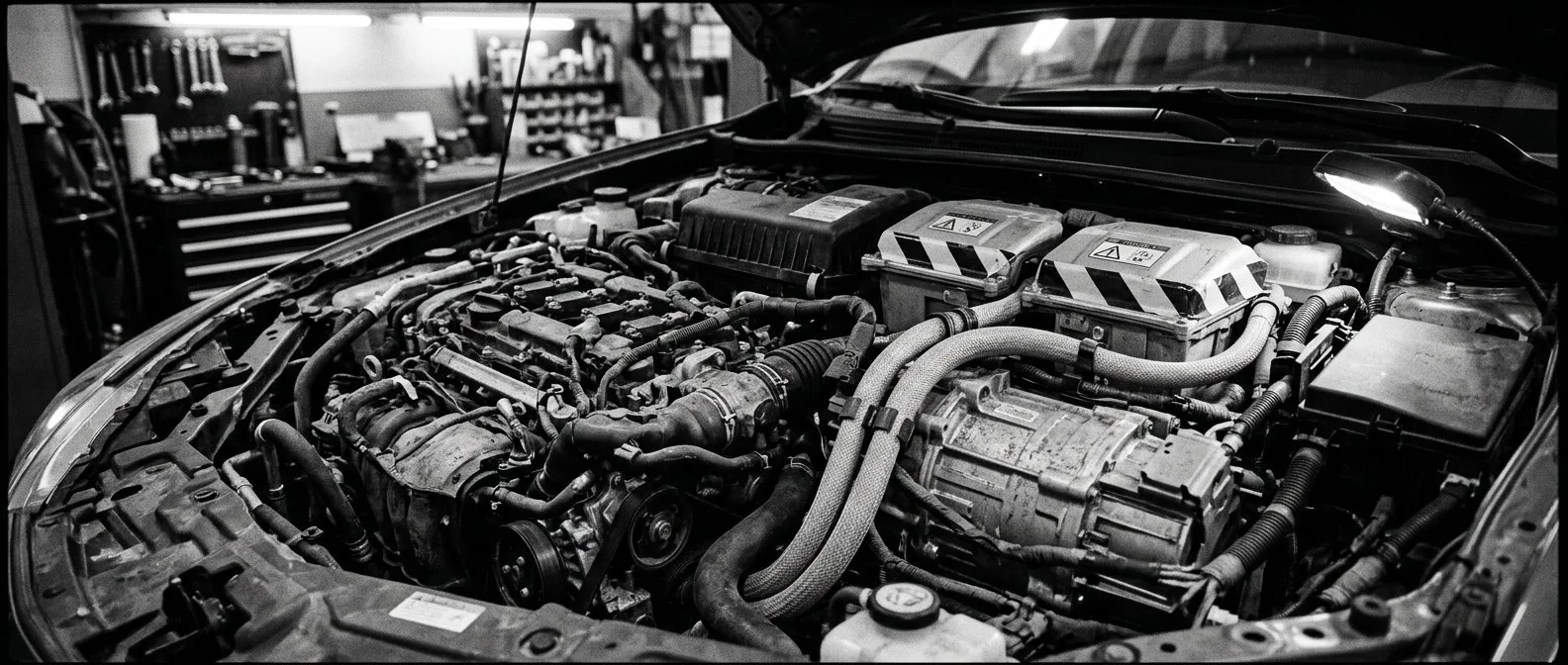
Hybrids get inspected as though they were ordinary petrol cars far more often than they should be. The engine, transmission and body get a thorough look; the high-voltage battery — the component most likely to produce a large unexpected bill — gets a glance at the dash and a shrug. That is the gap this inspection exists to close.
Hybrid, plug-in hybrid, and why the difference matters
A conventional hybrid has a small high-voltage battery that is charged by the engine and by regenerative braking, never plugged in. A plug-in hybrid has a much larger pack, charges from a wall socket or charger, and drives meaningful distances on electricity alone.
That difference changes the whole assessment. A plug-in hybrid's pack does real work and ages like an EV's, so state of health and charge history matter. A conventional hybrid's pack cycles constantly across a narrow band, and the failure patterns are different again — cooling, module imbalance and cells that have simply aged out. Both need reading; neither reads the same way.
What we check on a hybrid
Everything a conventional pre-purchase inspection covers, plus the electric side that makes it a hybrid.
High-voltage battery condition
Capacity and cell voltage spread read from the vehicle's own systems. On a plug-in hybrid this is the number that moves the price. On a conventional hybrid it is the difference between a car with years left and one about to need module work.
Battery cooling system
Many hybrid packs are air-cooled through a cabin intake that quietly fills with dust and pet hair. A blocked intake cooks the pack slowly, and it is one of the most common findable, fixable faults on an older hybrid.
Charging system, on plug-in hybrids
A live charge session where the car supports it. Intermittent charging faults do not appear reliably in a stationary scan on any platform.
Engine, transmission and the conventional car
It is still a petrol car underneath. Oil condition, cooling system, transmission behaviour, exhaust, suspension, brakes, structure and paint depth all get the standard treatment.
Brakes, which behave differently here
Regenerative braking means the friction brakes do far less work, so pads last unusually well while calipers and hardware seize from underuse. Low pad wear on a hybrid is not automatically good news.
Recall status and warranty position
Outstanding campaigns checked against the VIN, plus where any high-voltage battery warranty stands — term, distance limit and whether it transfers to you.
Buying a hybrid in Brisbane, Sydney or Melbourne
Heat is the recurring theme in this climate. Sustained high temperatures are hard on any lithium pack, and hybrids that spend their lives parked outside in Brisbane and Ipswich summers age differently to garaged cars. That is worth knowing before you compare two identical listings on odometer alone.
We inspect on site across Brisbane, Sydney, Melbourne, the Gold Coast, Ipswich, Logan and the Redlands — see how the mobile service works.
If you are cross-shopping a hybrid against an EV
It is a common position, and the inspection answers it usefully: a measured battery figure on both cars tells you which one is actually the safer buy, rather than which one sounds safer.
Our model pages cover the used EVs selling here, and the buyer guides explain battery health, warranty checks and what degradation is normal.
Hybrid inspection questions
Do you inspect hybrids as well as electric cars?
Yes — hybrids and plug-in hybrids, alongside fully electric vehicles. What they have in common is a high-voltage battery, which is the part a conventional inspection is not equipped to assess.
Can a normal mechanic inspect a hybrid?
A good mechanic will assess the petrol side properly. What generally does not happen is a genuine read of the high-voltage battery, because that needs specific diagnostic equipment and a high-voltage safety procedure. On a hybrid that is the most expensive component to get wrong.
How long do hybrid batteries last?
Often the life of the car, and failures are usually specific rather than gradual — a module, a cooling problem, or a cell that has aged out — rather than the whole pack quietly wearing away. That is why a reading matters more than an assumption in either direction.
Is a plug-in hybrid inspected like an EV or like a petrol car?
Both, which is exactly the point. The pack, charging system and electric drive are assessed the way we assess an EV, and the engine, transmission and conventional mechanicals get a standard pre-purchase inspection.
What does a hybrid inspection cost?
The same as our EV packages — Essential is $349 and Complete is $479, including GST and mobile call-out inside our service area.
Two drivetrains. Get both of them checked.
Hybrid, plug-in hybrid or fully electric — inspected where the car is.