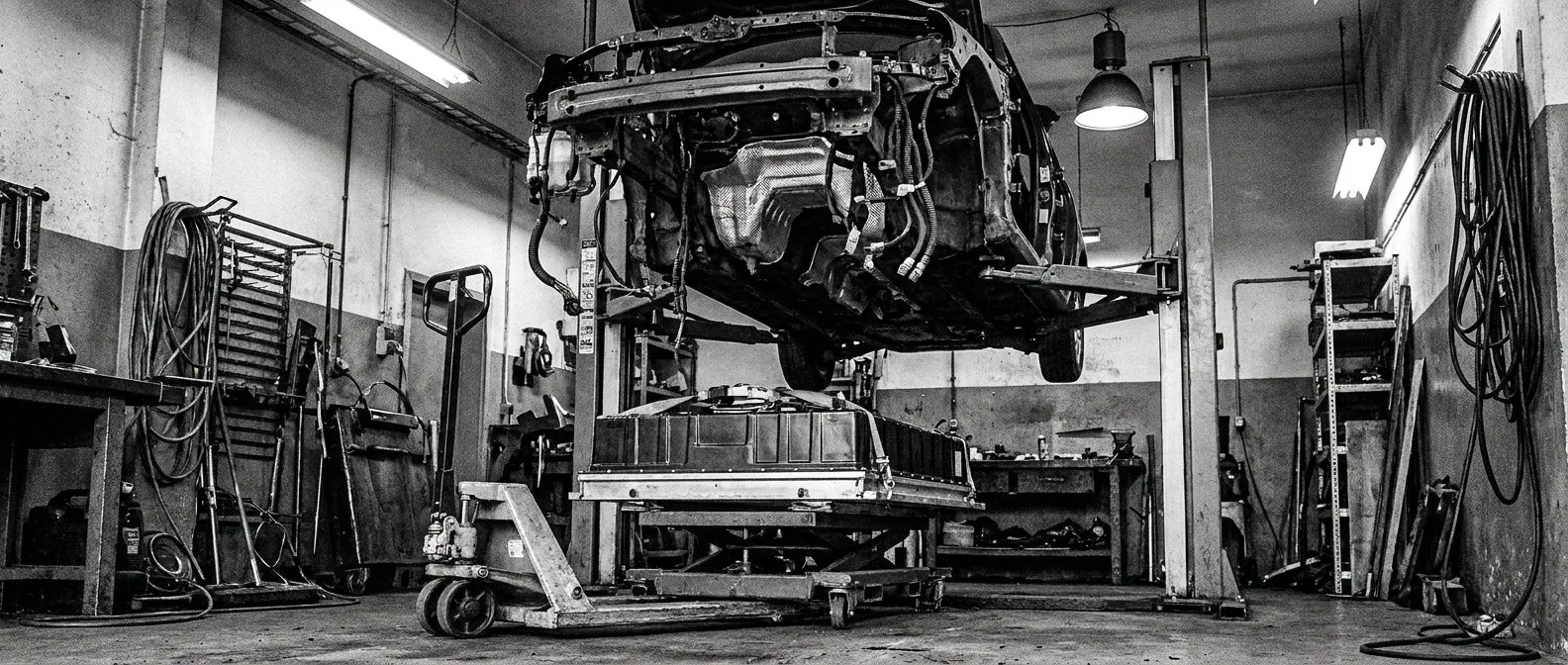
For any early Kona Electric, one question comes before all others: what happened with the battery recall on this specific VIN? A car with a documented replacement pack and the paperwork to prove it is worth materially more than an identical car where nobody can say.
Which one are you looking at?
Two generations, and within the first, a significant difference between pre- and post-recall cars. Verify the VIN history rather than the model year.
| Variant | Battery | What it changes |
|---|---|---|
| Standard Range (first gen) | ~39 kWh | City-focused. Less common used, and priced accordingly. |
| Extended Range (first gen) | ~64 kWh | The volume car. Recall and pack replacement history is the key question. |
| Post-recall replaced pack | ~64 kWh | Effectively a much younger battery. A genuine advantage — if documented. |
| Second generation (2024 onward) | ~48 / 65 kWh | New platform, still in warranty. Focus on service history and repairs. |
What goes wrong on a Kona Electric
Mechanically one of the sounder options. The complications are mostly historical and administrative.
Battery recall status and replacement paperwork
Early Kona Electrics were subject to a high-profile battery recall, with packs replaced on many cars. We check the VIN against the recall record and look for evidence of what was actually done — a replaced pack is a selling point, but only with documentation behind it.
Warranty position on a replaced pack
Where a pack has been replaced, the cover that applies to it is not always what a buyer assumes. Confirm the terms for that specific pack with a dealer in writing before you use it as a reason to pay more.
12-volt and charging control faults
Charging and low-voltage electrical faults come up on these. A live charge session catches problems a stationary scan will not, which is why we run one on every inspection.
Brake corrosion and lightly used friction brakes
Strong regenerative braking means the friction brakes get little work. In coastal and bayside suburbs the discs corrode and calipers stick — common, cheap, and a fair negotiating point.
Tyres, suspension and heavy-car wear
The usual EV pattern: uneven inner-edge wear, tired bushes and replacement tyres chosen on price rather than specification.
The battery on this one
Kona Electrics are efficient, and a healthy pack in one of these delivers real-world range that still compares well with much newer cars. That makes the state of health figure the difference between a bargain and an expensive mistake — particularly on a car whose recall history is unclear.
We measure usable capacity and cell voltage spread directly, then read it against the car's age, kilometres and pack history. See how the test works, and what a pack costs if you need to price the downside.
Buying one in Brisbane, Sydney or Melbourne
Early Konas trade at a discount here because buyers remember the recall and are not sure what to make of it. That is an opportunity if you can establish the facts. Get the VIN, confirm the recall and replacement position with Hyundai in writing, and have the pack measured — three steps that turn an uncertain car into a straightforward one.
We inspect on site across Brisbane, Sydney, Melbourne, the Gold Coast, Ipswich, Logan and the Redlands — at a private seller's home, a dealer forecourt or a workplace car park. Report in writing inside 24 hours, then a call to walk you through it.
Questions we get about the Kona Electric
Was my Hyundai Kona Electric affected by the battery recall?
Early Kona Electrics were subject to a battery recall, with packs replaced on many affected vehicles. Whether a specific car was affected and what work was done can be confirmed against the VIN with Hyundai, and we check this as part of the inspection.
Is a Kona with a replaced battery a good buy?
Often it is one of the better buys in the segment, because the pack is effectively much younger than the car. The value depends on documentation — a replacement you can prove is worth far more than one the seller merely believes happened.
How much range should a used Kona Electric have?
These are efficient cars, and a healthy extended-range example still delivers strong real-world range. Rather than trusting the dashboard figure, we measure usable capacity from the battery management system and compare it against the original specification for the variant.
Do you inspect the second-generation Kona Electric?
Yes. Newer cars are mostly still in warranty, so the emphasis shifts to repair history, service record and confirming that the battery and charging systems behave properly under load.
Settle the recall question with evidence.
VIN-checked recall history, a measured pack and the warranty position, in one visit.