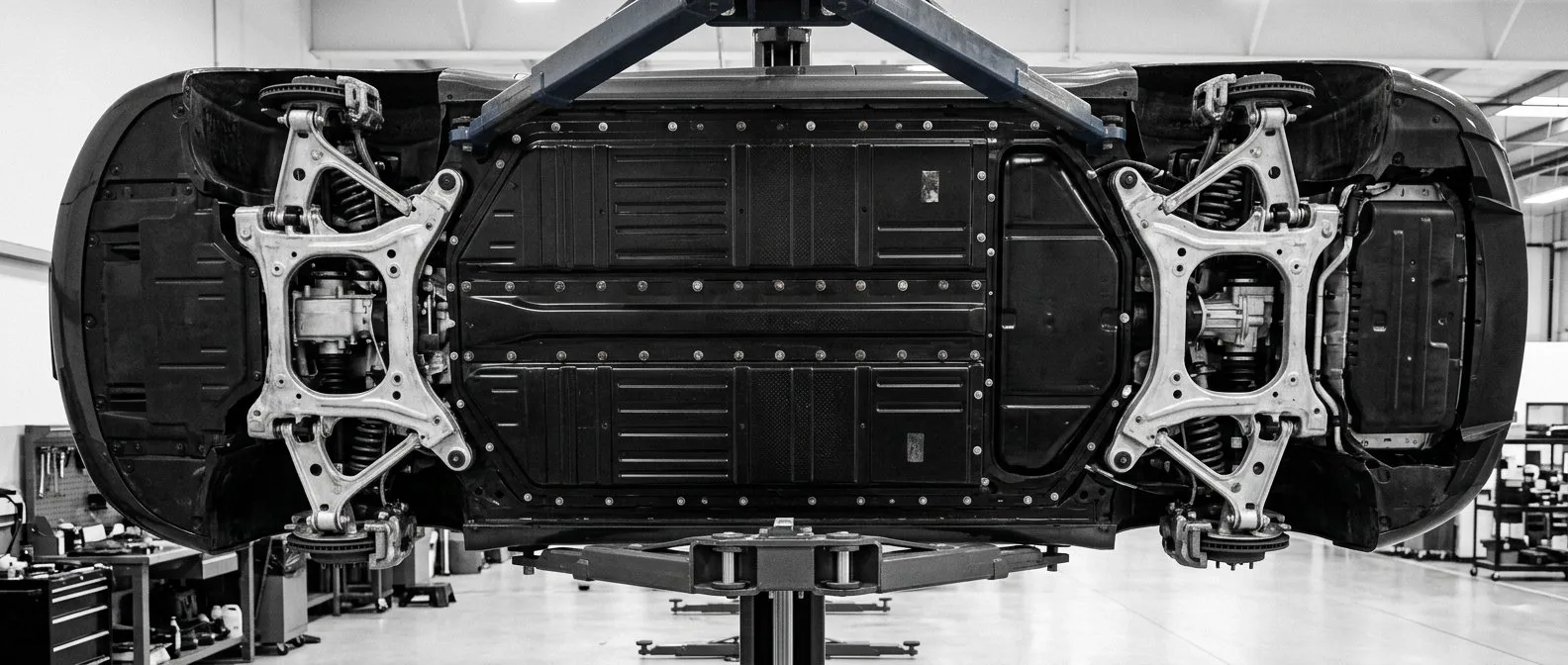
The battery
Unaffected. Salt does not reach the cells or change the chemistry
The real risk
Fasteners, subframe mounts and high-voltage connector housings
Why it matters more on an EV
A corroded HV connector housing is a safety item, not a cosmetic one
On a combustion car, surface corrosion under the floor is an annoyance. On an electric car, corrosion at a high-voltage connector housing is a reason to stop the inspection.
Why an EV cares about salt
Salt-laden air accelerates galvanic corrosion wherever dissimilar metals meet and moisture can sit. That is true of any car parked within a few kilometres of the ocean or a bay, and it is why coastal vehicles across Australia show underbody corrosion years earlier than inland ones.
The battery pack itself is not the concern. Cells are sealed inside a case with its own thermal and moisture management, and salt in the air does not reach them or change their chemistry. What salt reaches is everything that fastens, seals and connects — and on an electric car some of those items carry several hundred volts.
Where it shows up first
Corrosion follows moisture, so it starts where water sits and air does not move. On most EVs that means the same short list every time.
- Subframe mounting points and suspension fasteners, particularly at the rear
- Battery pack case fixings and the underbody shielding that protects them
- High-voltage connector housings and their seals
- Brake components, which corrode faster on EVs because regenerative braking means the friction brakes are barely used
- Door and hatch seals, where trapped salt residue degrades rubber and opens water paths
Why the connector housings matter most
High-voltage cabling on a modern EV runs in shielded, sealed housings designed to keep moisture out of the connection. Once salt has attacked the housing or its seal, moisture can reach a live connection — and the car’s own isolation monitoring may only flag it once the fault is already established.
That is why isolation resistance testing is part of every inspection we run, and why it matters more on a coastal car than an inland one. A reading that has drifted from specification is not always dramatic on the day; it is a reliable early indication that water is finding somewhere it should not be.
What is fixable and what is not
Surface corrosion on fasteners and brackets, caught early, is a cleaning and treatment job — a few hundred dollars and worth negotiating over, not walking away from. Seized brake components are similarly routine.
Corrosion that has reached a structural mounting point, or that has compromised a high-voltage connector housing or the battery case fixings, is a different conversation entirely. Those repairs are expensive, sometimes uneconomic, and on a used car near the end of its warranty they are frequently the reason to buy something else.
The practical rule is simple: on any car that has lived near the water, the corrosion check is not an optional extra. Ask where the car has been parked, then have it verified rather than trusting the answer.
Does salt air damage an EV battery?
No. The cells are sealed inside a case with their own thermal and moisture management, and airborne salt does not reach them or affect the chemistry. The risk is to fasteners, subframe mounts, battery case fixings and high-voltage connector housings.
Why is corrosion more serious on an electric car?
Because some of the corroded components carry several hundred volts. A degraded high-voltage connector housing can let moisture reach a live connection, which is a safety issue rather than a cosmetic one. Isolation resistance testing is how it is picked up early.
Which parts corrode first on a coastal EV?
Rear subframe and suspension fasteners, battery pack case fixings and underbody shielding, high-voltage connector housings and seals, and brake components — the last of these faster than on a petrol car, because regenerative braking means the friction brakes barely get used.
How close to the water is a problem?
There is no exact line, but cars parked within a kilometre or two of open ocean or a bay show it soonest, and cars washed regularly show it later than those that are not. Ten kilometres inland it stops being a routine concern.
Is corrosion always a reason to walk away?
No. Surface corrosion on fasteners and brackets caught early is a cleaning and treatment job worth negotiating over. Corrosion that has reached a structural mounting point, the battery case fixings or a high-voltage connector housing is a much more serious and often uneconomic repair.