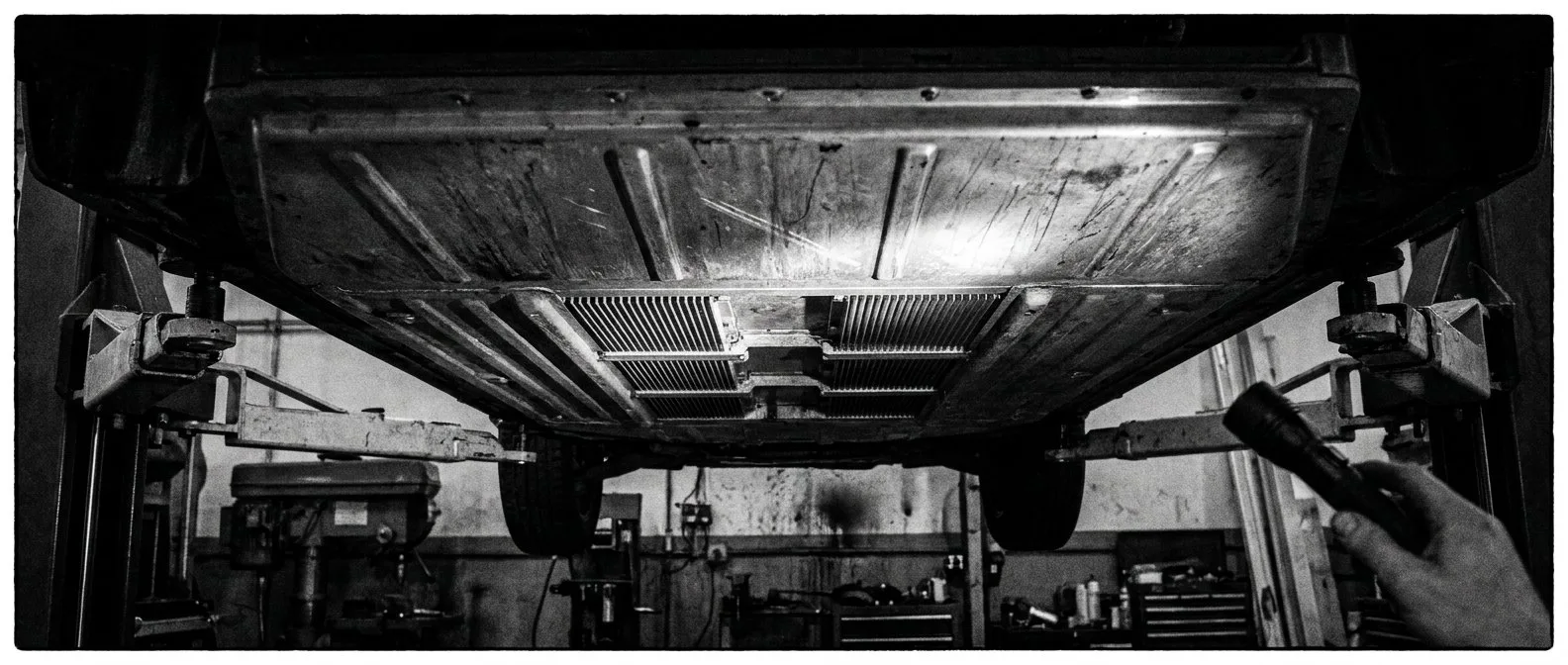
Leaf packs are passively cooled. In South East Queensland that is the whole story: heat is the main driver of degradation, and a Leaf that has spent its life here will not match the same car from a cooler state. The capacity bars on the dash are far too coarse to tell you where you stand.
Which one are you looking at?
Three broad eras, plus a large number of used Japanese imports. The generation and the import status change the risk profile completely.
| Variant | Battery | What it changes |
|---|---|---|
| ZE0 (2012–2013) | 24 kWh, air-cooled | Oldest packs, heaviest degradation in this climate. Buy on measured capacity only. |
| AZE0 (2014–2017) | 24 / 30 kWh, air-cooled | Improved chemistry, still passively cooled. 30 kWh cars need careful assessment. |
| ZE1 (2019 onward) | 40 / 62 kWh, air-cooled | Much better car. Still no liquid cooling — repeat DC charging causes heat-related taper. |
| Japanese used import | Varies | No Australian warranty, different equipment, and compliance paperwork to verify before you buy. |
What goes wrong on a Leaf
The mechanical side of a Leaf is generally trouble-free. Almost everything that matters is about the pack and the paperwork.
Heat-driven capacity loss
The defining Leaf issue in Queensland. Without liquid cooling, a pack that lives outdoors in the sun and gets fast charged degrades measurably faster than the same car interstate. Age alone is a poor predictor — it has to be measured.
Capacity bars that hide the truth
The dash shows twelve bars. The first one does not disappear until a substantial amount of capacity is already gone, and each bar after that covers a wide band. A car showing "eleven bars" can sit anywhere across a wide band of real capacity.
Repeat fast-charging taper
On consecutive DC sessions the pack heats up and charging slows dramatically. It is normal behaviour for the design, not a fault — but it makes some Leafs unsuitable for the long trips buyers imagine, and it is better learned before purchase.
Import compliance and history gaps
Used Japanese imports are common and can be good value. They also come with no local warranty, sometimes different charging equipment, and a history that stops at the border. Verify the compliance paperwork and the odometer independently.
The ordinary car around the battery
Rear brake corrosion from regen, tired suspension, worn tyres and a 12-volt battery nobody has thought about in years. All cheap, all worth finding before you agree a price.
The battery on this one
On a Leaf, the state of health reading is not one factor among many — it is the car's value. We read usable capacity and cell voltage spread directly from the battery management system, which is the only way to distinguish a well-kept garaged example from one that has been cooking on a driveway for eight years.
Expect a Leaf to sit below the general degradation table for its age; that is the design, not necessarily a fault. What matters is where it sits relative to other Leafs of the same year. Background on both is in what degradation is normal and how the test works.
Buying one in Brisbane, Sydney or Melbourne
A cheap Leaf can be an excellent second car for school runs and commuting — if you buy it on measured capacity rather than on the bars and the asking price. The ones to be careful with are cars that have lived outdoors on the coast or western suburbs, and imports whose history cannot be verified. A measured figure turns both into a straightforward pricing conversation.
We inspect on site across Brisbane, Sydney, Melbourne, the Gold Coast, Ipswich, Logan and the Redlands — at a private seller's home, a dealer forecourt or a workplace car park. Report in writing inside 24 hours, then a call to walk you through it.
Questions we get about the Leaf
How many capacity bars should a used Leaf have?
Bars are too coarse to buy on. The first bar disappears only after a significant amount of capacity is already gone, and each bar covers a wide range. Two cars showing the same bar count can differ substantially in real capacity and real value.
Do Nissan Leaf batteries degrade faster in Queensland?
Yes. The pack is passively cooled rather than liquid cooled, so sustained heat has more effect than it does on most rivals. A Leaf that has lived in South East Queensland will generally test lower than the same car and year from a cooler climate.
Should I buy an imported Leaf?
They can be good value, but they carry no Australian manufacturer warranty, may have different equipment, and have a history that is hard to verify. Have the pack measured and the compliance paperwork checked before you commit.
Is an older Leaf still worth buying?
As a short-range second car bought on a measured capacity figure, often yes. As a car you expect to do long trips in, usually not — repeat fast charging slows considerably as the pack warms.
On a Leaf, the battery is the car.
A measured capacity figure, not a bar count — before you agree on a price.